
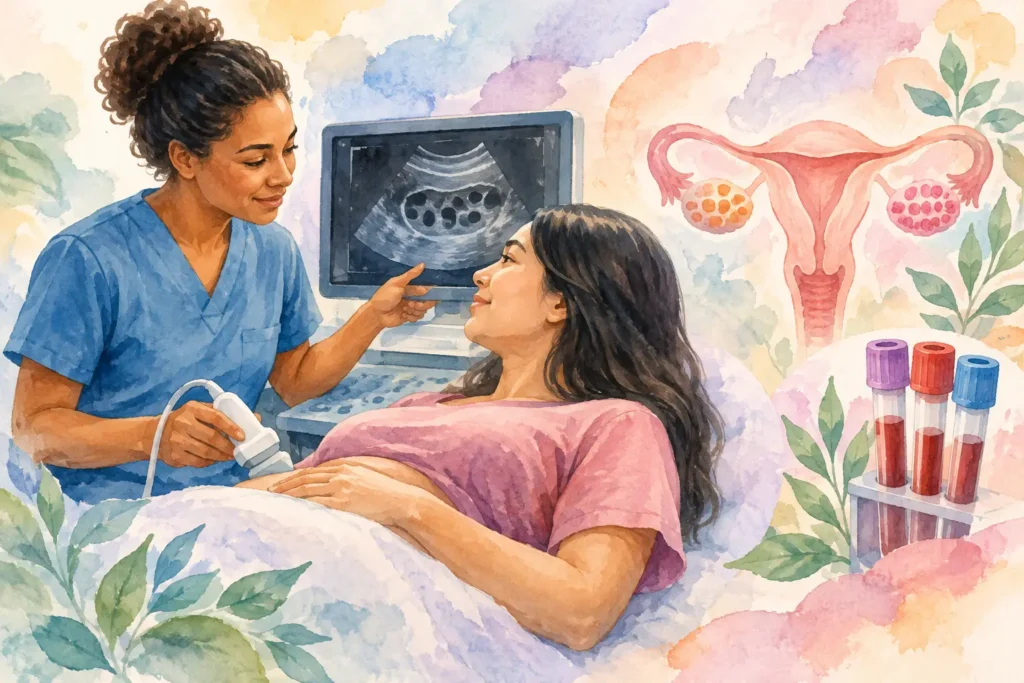
A missed or irregular period, new facial hair growth, persistent acne or difficulty conceiving can leave you looking for clear answers. The best blood markers for PCOS can help build that picture, but no single result can confirm the condition on its own. A careful assessment brings together your symptoms, menstrual history, blood results and, where appropriate, an ultrasound scan.
Polycystic ovary syndrome, or PCOS, is common and highly individual. Some people have raised androgen hormones and irregular ovulation; others have insulin resistance or changes visible on an ultrasound scan. Some have a mixture of all of these. Thoughtful testing helps your clinician understand what may be driving your symptoms, rule out other causes and discuss the most suitable next step for you.
What blood tests can and cannot tell you about PCOS
In UK clinical practice, PCOS is usually assessed using recognised diagnostic criteria. This may include at least two of the following: irregular or absent ovulation, clinical or biochemical signs of raised androgens, and polycystic ovarian appearance on ultrasound. Other medical conditions that can cause similar symptoms should also be excluded.
Blood tests are particularly useful when symptoms suggest higher androgen levels, such as excess coarse hair growth, acne or scalp hair thinning. They also assess longer-term health considerations linked with PCOS, including blood sugar and cholesterol levels. However, normal blood results do not automatically rule PCOS out, and an abnormal result needs context. Laboratory reference ranges, your age, medication, cycle timing and the method used to analyse the sample can all affect interpretation.
The best blood markers for PCOS assessment
Testosterone and free androgen assessment
Testosterone is often one of the most informative starting points. Although commonly thought of as a male hormone, everyone produces testosterone in different amounts. In PCOS, the level may be raised, contributing to acne, unwanted facial or body hair, and sometimes hair thinning from the scalp.
Your clinician may request total testosterone alongside sex hormone-binding globulin, known as SHBG. SHBG is a protein that carries sex hormones in the bloodstream. When SHBG is lower, more testosterone may be available to act on body tissues. A calculated free androgen index, or a calculated free testosterone result, can therefore be more revealing than total testosterone alone.
A very high testosterone result is not typical of PCOS and should be reviewed promptly. It may lead to further investigations for other, less common causes of androgen excess. The speed at which symptoms developed matters too. Gradual hair growth over years is different from sudden, marked changes over months.
DHEAS and androstenedione
DHEAS, short for dehydroepiandrosterone sulphate, is an androgen produced mainly by the adrenal glands. Androstenedione is another hormone made by both the ovaries and adrenal glands. These tests can provide useful additional detail when testosterone is normal but symptoms strongly suggest androgen excess, or when the source of raised androgens needs clarifying.
They are not needed in every case. The right panel depends on your symptoms and clinical history, rather than simply ordering every available hormone test.
LH and FSH
Luteinising hormone, or LH, and follicle-stimulating hormone, or FSH, both have a role in ovulation. Some people with PCOS have a higher LH level relative to FSH, but this pattern is neither sensitive nor specific enough to diagnose PCOS. Many people with the condition have entirely unremarkable LH and FSH results.
These markers can still be helpful in a fertility or menstrual health assessment. FSH may also help clinicians consider other explanations for absent periods, depending on your age and circumstances. Results are most useful when they are interpreted with your cycle history rather than treated as a simple ratio.
Prolactin and thyroid function
Raised prolactin can interfere with periods and ovulation. Thyroid conditions can also cause changes in periods, fertility, weight, mood and energy that may overlap with PCOS symptoms. For that reason, prolactin and thyroid-stimulating hormone, or TSH, are often included when periods are infrequent or absent.
If prolactin is mildly raised, the test may need repeating. Stress, recent exercise, nipple stimulation and even the anxiety of a blood test can affect the result. A clinician may advise how to prepare for a repeat sample if needed.
17-hydroxyprogesterone
17-hydroxyprogesterone, usually shortened to 17-OHP, helps screen for a rarer hormone condition called non-classic congenital adrenal hyperplasia. It can cause irregular periods, acne and increased body hair that look very similar to PCOS.
This marker is usually taken in the morning and may be timed for the early part of the menstrual cycle where possible. If it is raised, further specialist testing may be required. Including it where clinically appropriate is a valuable part of making sure PCOS is not assumed too quickly.
Metabolic markers that matter just as much
PCOS is not only about periods, fertility or visible symptoms. It can be associated with insulin resistance, where the body needs to produce more insulin to manage blood glucose. This can occur at any body size, so metabolic checks should not be based on appearance alone.
HbA1c and glucose testing
HbA1c shows your average blood glucose level over roughly the previous two to three months. It is convenient because fasting is not usually required. A fasting glucose test may also be used, and some people will be advised to have an oral glucose tolerance test. This involves drinking a measured glucose drink followed by timed blood samples, and can identify impaired glucose handling that routine tests may miss.
Which option is most appropriate depends on factors such as previous gestational diabetes, family history, ethnicity, weight, PCOS symptoms and whether you are planning a pregnancy. If you are pregnant, testing should be arranged through your maternity team, as pregnancy has its own screening pathway.
Lipid profile
A lipid profile measures fats in the blood, including total cholesterol, LDL cholesterol, HDL cholesterol and triglycerides. PCOS can be linked with unfavourable cholesterol patterns, even when you feel well. Knowing your baseline supports practical conversations about nutrition, activity, sleep, medication where appropriate and future monitoring.
Fasting insulin: useful, but not a diagnosis
Fasting insulin is commonly requested in private hormone panels, but it deserves careful interpretation. Insulin levels naturally vary, laboratory methods differ, and there is no single fasting-insulin cut-off that diagnoses insulin resistance or PCOS. It can add context in selected cases, particularly alongside fasting glucose, but it should not be used in isolation to label someone as insulin resistant.
Do you need AMH testing?
Anti-Müllerian hormone, or AMH, is made by small developing follicles in the ovaries. Levels are often higher in people with PCOS, which is why it is sometimes included in fertility or hormone testing. Yet a high AMH does not prove PCOS, and a normal level does not exclude it.
AMH is more often used to help assess ovarian response in fertility treatment than to answer every question about irregular cycles. It is also not a direct measure of egg quality or a guarantee of fertility. If pregnancy is your goal, your clinician will consider AMH alongside your age, ovulation pattern, partner factors, medical history and, where needed, ultrasound findings.
When should PCOS blood tests be taken?
Timing can make a real difference. If you have periods, several reproductive hormone tests are often most informative early in the cycle, commonly between days two and five. This is not always possible when cycles are very irregular, so your clinician may recommend another approach.
Hormonal contraception can alter testosterone, SHBG, LH, FSH and other results. Do not stop prescribed contraception solely to arrange a test. Instead, tell the clinician or phlebotomist exactly what you take, including the pill, implant, injection, hormone replacement therapy, supplements and any medication for acne or hair growth. They can advise whether testing is still worthwhile or whether timing needs to be adjusted.
Morning sampling may be preferred for some hormone markers, including 17-OHP and certain androgen tests. If fasting glucose, insulin or a lipid profile is requested, ask in advance whether you should avoid food and calorific drinks beforehand. Water is usually acceptable, but follow the instructions provided for your appointment.
Why ultrasound still has a role
A pelvic ultrasound can assess the appearance of the ovaries and look for other possible explanations for pelvic symptoms. It may be performed externally through the lower abdomen or internally with a transvaginal probe, depending on your circumstances, consent and clinical need. The term “polycystic ovaries” refers to a pattern of multiple small follicles, not harmful cysts that need removing.
An ultrasound finding alone does not diagnose PCOS. Equally, you can have PCOS without a polycystic ovarian appearance, especially if you meet other criteria. For younger people and those soon after starting periods, ultrasound is often less helpful diagnostically because ovarian appearance can naturally be more follicle-rich.
At Miracle Scan, diagnostic imaging and blood testing can form part of a considered reproductive health assessment, with results explained clearly and sensitively. If your symptoms are affecting your confidence, your plans for pregnancy or your day-to-day wellbeing, you deserve more than a number on a report. A clinician who considers the full picture can help you move forward with clarity and appropriate support.