
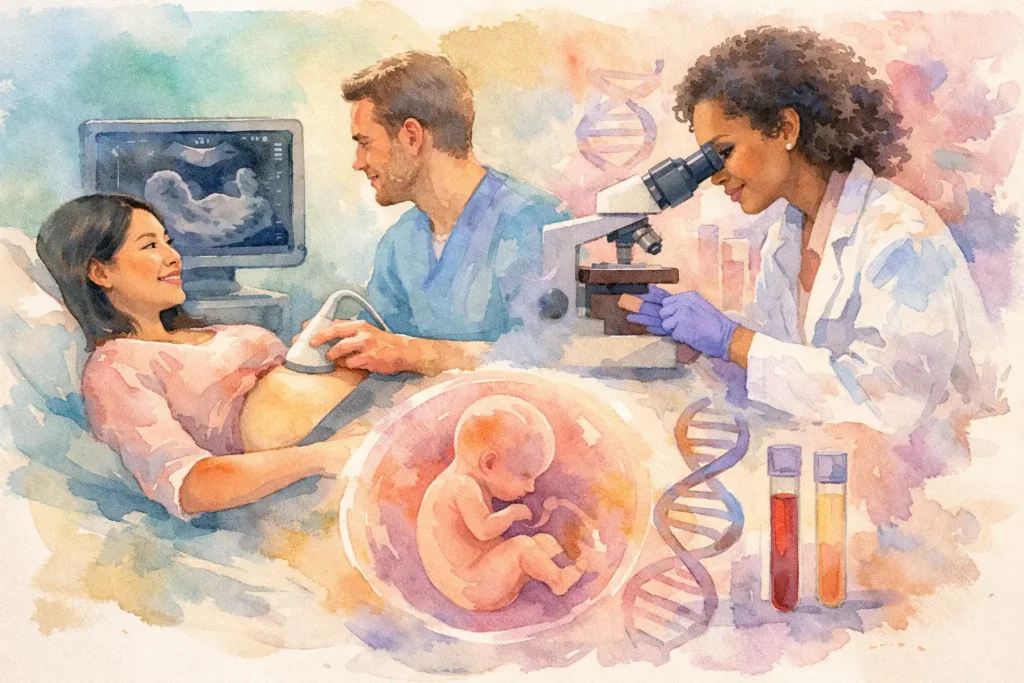
A result that arrives by text, email or phone call can feel much bigger than a blood test. This NIPT test review explains what non-invasive prenatal testing can and cannot tell you, so you can approach screening with clear expectations and the right support around you.
NIPT analyses small fragments of DNA from the pregnancy that circulate in the pregnant person’s blood. It is most commonly used to assess the chance of certain chromosome conditions, including Down’s syndrome (trisomy 21), Edwards’ syndrome (trisomy 18) and Patau’s syndrome (trisomy 13). It does not involve a needle near your baby, which is why many parents find it a reassuring option when they want earlier information.
What is NIPT screening?
NIPT is a screening test, not a diagnostic test. That distinction matters. Screening estimates whether a pregnancy has a high or low chance of a particular condition. A diagnostic test can confirm whether the condition is present.
The sample is taken from your arm, much like any other routine blood test. In the laboratory, it is analysed for cell-free DNA, including placental DNA that usually reflects the baby’s chromosomes. Most people can have NIPT from 10 weeks of pregnancy, although the right timing for you should be confirmed as part of your appointment.
A scan is often an important part of the process. Confirming the pregnancy dating, checking for a heartbeat and establishing whether there is one baby or more helps ensure screening is appropriate and results can be interpreted accurately. If you are unsure how far along you are, a dating scan may be helpful first.
NIPT test review: accuracy, scope and limits
For the three main trisomies, NIPT is generally more accurate than traditional combined screening. It is particularly effective at identifying pregnancies with a low chance of Down’s syndrome. However, no screening test offers a guarantee, and accuracy is not identical for every condition or every pregnancy.
A high-chance result does not mean a baby definitely has the condition. It means further assessment is recommended. Equally, a low-chance result is very reassuring but cannot rule out every chromosome, genetic, structural or developmental condition. Routine antenatal scans remain important, even after a low-chance NIPT result.
Different NIPT panels also cover different conditions. Standard testing usually focuses on trisomies 21, 18 and 13. Some tests may include sex chromosome differences or optional screening for selected microdeletions. Broader testing may sound appealing, but more information is not always more helpful. Less common conditions can be harder to screen for accurately and may lead to uncertain findings or a greater need for follow-up.
The best choice depends on your medical history, scan findings, family history and how you feel about receiving information that may be less definitive. A good provider will explain precisely what the selected test includes before your blood is taken, rather than assuming every family wants the same level of screening.
When might NIPT be a good option?
Some parents choose NIPT because they want earlier reassurance after a previous difficult pregnancy, fertility treatment or pregnancy loss. Others have received a higher-chance result from combined screening and would like more detailed screening before deciding whether diagnostic testing is right for them.
It can also suit parents who would prefer a private appointment, a calm setting and time to ask questions without feeling rushed. NIPT is not only for older mothers or those with a known risk factor. However, the value of the test is personal. For some families, the standard NHS screening pathway provides the information they need. For others, private NIPT feels like a worthwhile part of their antenatal care.
If an ultrasound shows a structural concern, your healthcare professional may discuss whether a diagnostic test could be more appropriate than further screening. In this situation, getting the clearest possible answer quickly may be more useful than a screening result alone.
Understanding high-chance, low-chance and no-result findings
The language used in a result can sound clinical, especially when you are waiting for news about your baby. In simple terms, a low-chance result means the test has found a low likelihood of the specific conditions screened. You would usually continue with your normal antenatal care and planned scans.
A high-chance result needs sensitive, prompt follow-up. Your provider should explain the finding clearly and arrange or advise referral for specialist counselling and diagnostic testing through your maternity team. Diagnostic options may include chorionic villus sampling (CVS) or amniocentesis, depending on your stage of pregnancy and individual circumstances. These tests can provide a definitive answer, but they are invasive procedures, so the benefits and small procedure-related risks should be discussed carefully.
Occasionally, a laboratory cannot issue a result. This is often called a no-call or no-result result. It can happen when there is not enough placental DNA in the blood sample, which may be more likely earlier in pregnancy or for a range of biological reasons. A no-result does not automatically mean there is a problem, but it should not be ignored. Depending on the circumstances, the next step may be a repeat sample, an ultrasound assessment or discussion with your maternity team.
Questions worth asking before you book
The most reassuring appointment is one where you understand what will happen before you arrive. Ask which conditions the test screens for, whether a scan is included or recommended, and how results will be communicated. It is also sensible to ask about the expected turnaround time and what support is available if the result needs further discussion.
You may also want to ask how twin pregnancies, a vanishing twin, donor conception, surrogacy, maternal health conditions or recent transfusions could affect suitability or result interpretation. These circumstances do not always prevent NIPT, but they may change which test is appropriate or whether another pathway is advised.
If knowing fetal sex is part of your reason for considering NIPT, check whether this is included in the particular package. Remember that fetal sex information and chromosome screening are separate elements of the result, and availability can vary.
Choosing care that feels clinically safe and personally supportive
Pregnancy screening can bring reassurance, but it can also stir up worry you did not expect. Look for a service led by qualified healthcare professionals, with clear consent, transparent testing information and an established process for supporting unexpected results. A premium experience should never mean pressure to choose a bigger test panel. It should mean you have the time, privacy and professional guidance to make an informed decision.
At Miracle Scan, NIPT appointments are designed to combine careful clinical information with the warmth expectant families deserve. Your questions matter, whether you are seeking reassurance after an anxious few weeks or simply want to understand your screening options more fully.
The right next step is the one that leaves you feeling informed rather than hurried. Speak openly with your midwife, obstetric team or qualified screening provider, and give yourself permission to ask for explanations in plain English. Your pregnancy journey deserves both medical clarity and compassionate care.